Sunday, May 29, 2011

2011 All American 5K - Race Report

Jim, Mary Ann, Susan and I headed to Peachtree City on Saturday, May 28th, 2011 for the 2nd annual All American 5K foot race.  This year’s race honored Ashley Kurpiel and raised $6,000 to $7,000 for the International Fibrodysplasia Ossificans Progressiva (FOP) Association.  The race was hosted by the Peachtree City Running Club.  Although this is a low-key event, you knew it was well done because that’s just the way they seem to do it in PTC.  The race started at 8am at The Fred.  There was plenty of parking and volunteers to direct traffic.  Jim and I both pre-registered.  I was offered a cotton hat or a cotton t-shirt at registration.  Jim was offered both.  He accepted the offer and later gave the shirt to my wife.

2011 All American 5K cotton hat
2011 All American 5K cotton t-shirt
The club had coffee and an over-abundance of breakfast treats all laid out on tables before and after the race.  They also had bananas, but I elected to overlook them for sweeter fare.

Breakfast Treats
Ashley Kurpiel, who suffers from FOP, speaking to the runners
The race director speaking to the runners
The race started on time with bicyclists leading the way for the front runners.  Police officers blocked the roads, where needed, before the runners entered the famous Peachtree City cart paths.  The course below is correct except the start is in the parking lot with a right turn onto McIntosh Trail and the finish is on the cart path just before McIntosh Trail.


The Start
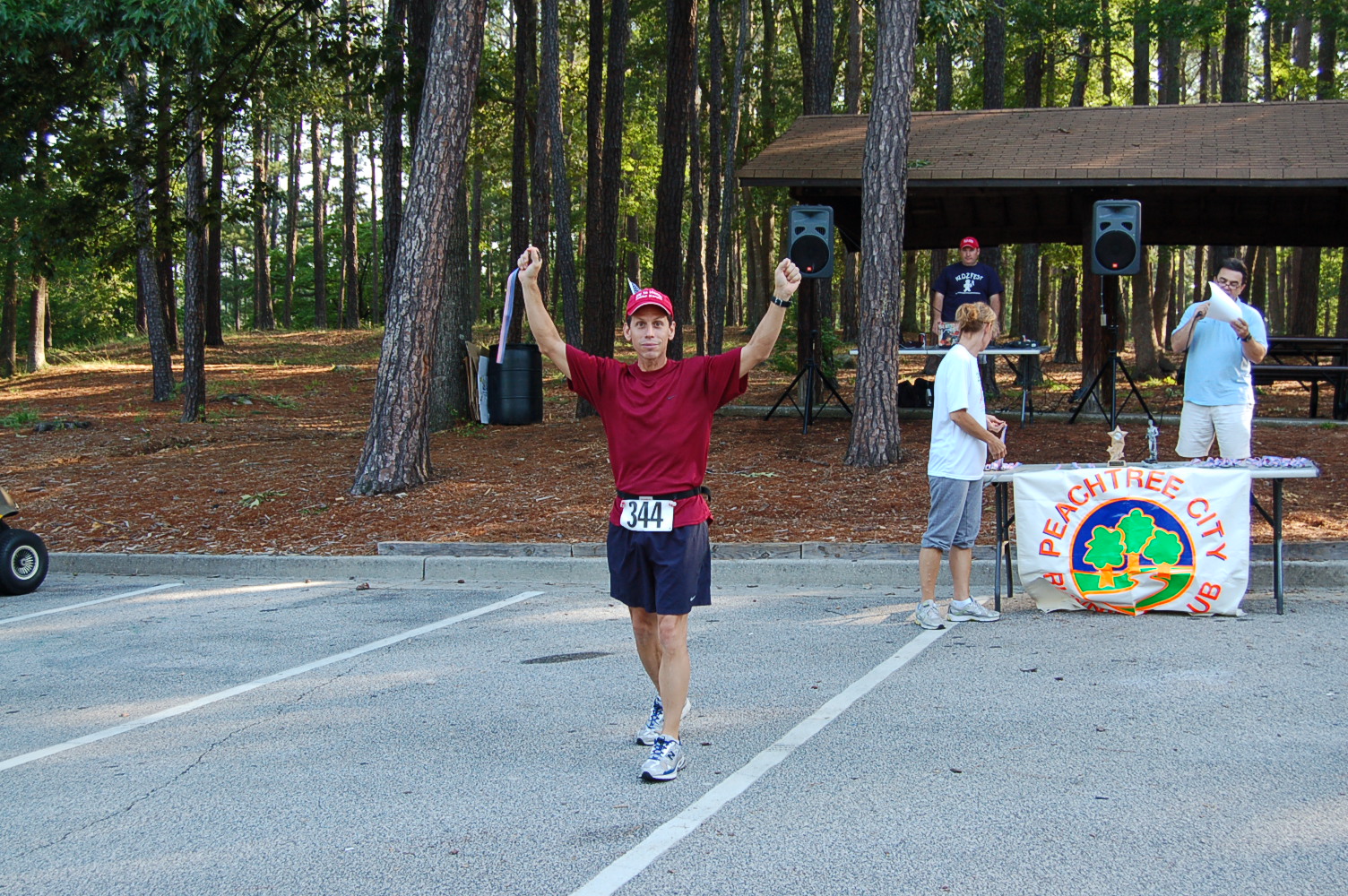
Me at the Finish
Jim at the Finish
Always the rabbit and never the turtle, I had the lead for a short time but soon gave it up to some young buck.  He was followed by two others.  It's important to know that I wasn't "chicked".  My co-workers use this as a gauge for my performance.  I finished in 4th place overall with a finish time of 19:19.  Timing was done with time cards.  Awards were given to the first 3 overall winners and age-group winners in 10 year increments.  I was first in the 40-49 age-group. There was no master’s award category.  Jim placed 2nd in the 70-79 age-group 33:09.

Me "Bringin' Home the Bacon"
Jim with another medal to add to his extensive collection
The age-group awards
I met one of my co-workers, Sean, his wife Julie and daughter Vivian at the race.  Sean and his family walked the course.

Julie, Sean and daughter Vivian
After the race, volunteers handed out American flags.

Mary Ann and Susan were official photographers of the Neil & Jim Running Team.

Mary Ann and Susan
We went to Ted’s Montana Grill in Peachtree City for an early lunch.  After that we stopped at Adams Farm for fresh fruit and veggies.

See more images from the 2011 All American 5K here. 
2011 All American 5K

Thursday, May 19, 2011

2011 Ironman Florida Participant Stats

I re-watched the 2010 Ironman Florida video on Universal Sports yesterday.  I had recorded the television broadcast on my DVR last year and watched it once or twice with my wife.  I had since deleted it from my recorder but Chip was kind enough to find it online for me.  I think he likes the fact that I have a little consternation about the swim.  Seeing the mass swim start again was something to behold and, for me, to be wary of.  I consider myself a good swimmer.  I’m not fast but I think I could swim in a washing machine.  The problem arises when I’m in the washing machine and someone or several people kick me in the head.


With the thoughts of getting hit in the head alive and well in my brain I thought I’d investigate just how many athletes might be in the water on November 5th.  I took the latest participants list on the Ironman Florida website and copied to Excel where I extracted the following numbers.

The 2011 Ironman Florida race has 3037 registered participants, 682 (22%) are female and 2355 (78%) are male.  Over 200 of them are fellow Georgians.

The chart below includes most of the female age groupers.

2011 Ironman Florida Female Age Group Registered Participants
The chart below includes most of the male age groupers.

2011 Ironman Florida Male Age Group Registered Participants
I don't know where I'll end up out of the estimated 226 male competitors in my age group, but I hope I do well. 

If you don't get Universal Sports from your satellite or cable tv provide, like me, you might want to install an over the air digital tv antenna like I did. 

These two blogs might help.
http://treadster.blogspot.com/2010/12/i-wanna-watch-ironman.html
http://treadster.blogspot.com/2010/12/whats-on-tv.html

Wednesday, May 18, 2011

Know The Course

After reading several race reports from this past weekend’s triathlons, one thing seems to ring clear.  Knowing the race course is very important.  This holds true for pros and age-groupers alike.  Age-groupers are hopefully less likely to go off course than would say, a pro averaging 25 mph on a bike course.  Everyone knows that it’s the responsibility of the athlete to know the course however, race directors should take some responsibility as well.  It seems to me that it’s the minutia that can make or break a race. The extra turn sign or a volunteer with healthy lungs who's not afraid to use them can make all the difference.
Often times a race director is working with volunteers and municipalities that are unfamiliar with an event or even the sport they are charged to support.  Most Americans have owned a bicycle at some time in their lives.  How many Americans have competed in a bike race or even watched one on TV?  I would guess the answer is very few.  Take that point a little further and ask the question, how may volunteers know what it’s like to ride a bike at 35+ mph?  Again, I would guess the answer is very few.

My point is that race directors have to make sure that their volunteers are knowledgeable about the course.  In many cases, volunteers are locals and more familiar with the specifics of a course than the race director.  Conversely, the athletes are often not locals and only familiar with the course as represented in race literature.  Volunteers should also be educated as to what riders might be experiencing and might expect as guidance during a race. I must say that most volunteers are awesome.  I couldn’t be more appreciative of the sacrifices that they make on and often before race day to help ensure that the athletes are safe and happy.

Taking from my own experience, I ran a 10K race this past weekend.  The front runner and I were neck and neck for the first 10 minutes of the race.  We were about 50 yards behind a police officer on a motorcycle.  As the motorcycle stopped to block an intersection we both hesitated for a second before we saw an orange course marker about 150 yards in the distance straight ahead.  That was the right turn we were both looking for.  I had reviewed the course and even created my own MapMyRun course map prior to the race. In the middle of a competition it’s easy to make a mistake.  We were on foot and not on bikes.  Had I been on my bike, that first intersection turn might have been it for me.

So, what can be done?  1) Design the course(s) accordingly.  2) Mark the course well and make sure those markers remain intact and are correct.  3) Educate the volunteers and police.  4) Provide the volunteers with the tools they need.  I like to see volunteers in identical race t-shirts.  5) Educate the athletes.  6) Educate area residents and business owners.

Mistakes will still happen and athletes will still go off course but hopefully that won’t happen often or with any dire consequences.

In keeping with the theme of this blog, I've included a map that I created for my next 5K foot race on May 28th. 


After I registered for the race I was unsure of the course and unable to find a map on the organizer's website, MapMyRun, or the USATF website.  I e-mailed the organizers, the Peachtree City Running Club, and within 48 hours I had a jpg map of the course in my inbox.

Monday, May 16, 2011

Peachtree Road Race Training

There are only 7 weeks left to literally the biggest race of my life, the Atlanta Track Club's 2011 Peachtree Road Race 10K on July 4th.  Sixty-thousand runners are expected in this year’s PRR.  That’s a lot of folks!  I’ve adjusted the focus of my training from triathlon specific swimming, cycling and running to be more running centric.  My 20 week training plan for Ironman Florida scheduled for November 5th will start on June 19th.  The PRR is just 2 weeks after that training starts.

Like many avid Atlanta runners, I’ve done my homework in preparation for this year's race.  To give me the best opportunity to do well I’ve run several races trying to get the best wave start position.  I think my preparation has worked.  Last year I started in the “A” group behind the invited stars of the sport, the seeded runners, and behind the sub-seeded runners.  This year I expect to start with the sub-seeded wave.

I recently read an article about the American marathon phenom, Ryan Hall.  In that article, Hall’s coach recommended that he train for and enter 1 mile distance races.  That’s considerably less than the 26.2 mile races he must be used to.  The article stated that the coach’s reasoning was that it would improve Hall’s speed.

As race day approaches I plan to introduce more speed work into my training.  Speed work is something I typically don’t do.  I’ll have to make a conscious effort to change that.  A part of that effort is to run some local 5K races.  I’ve signed up for the Peachtree City Running Club All American 5K on May 28th and the Virginia-Highlands Summerfest 5K on June 4th.

I don't yet know the All American 5K course.  An unofficial map of the Summerfest 5K course is below.


I’m hopeful that improving my 5K speed will also improve my 10K speed, and my marathon speed.  Ultimately I want to improve the finish time in my next really big race in November, Ironman Florida.